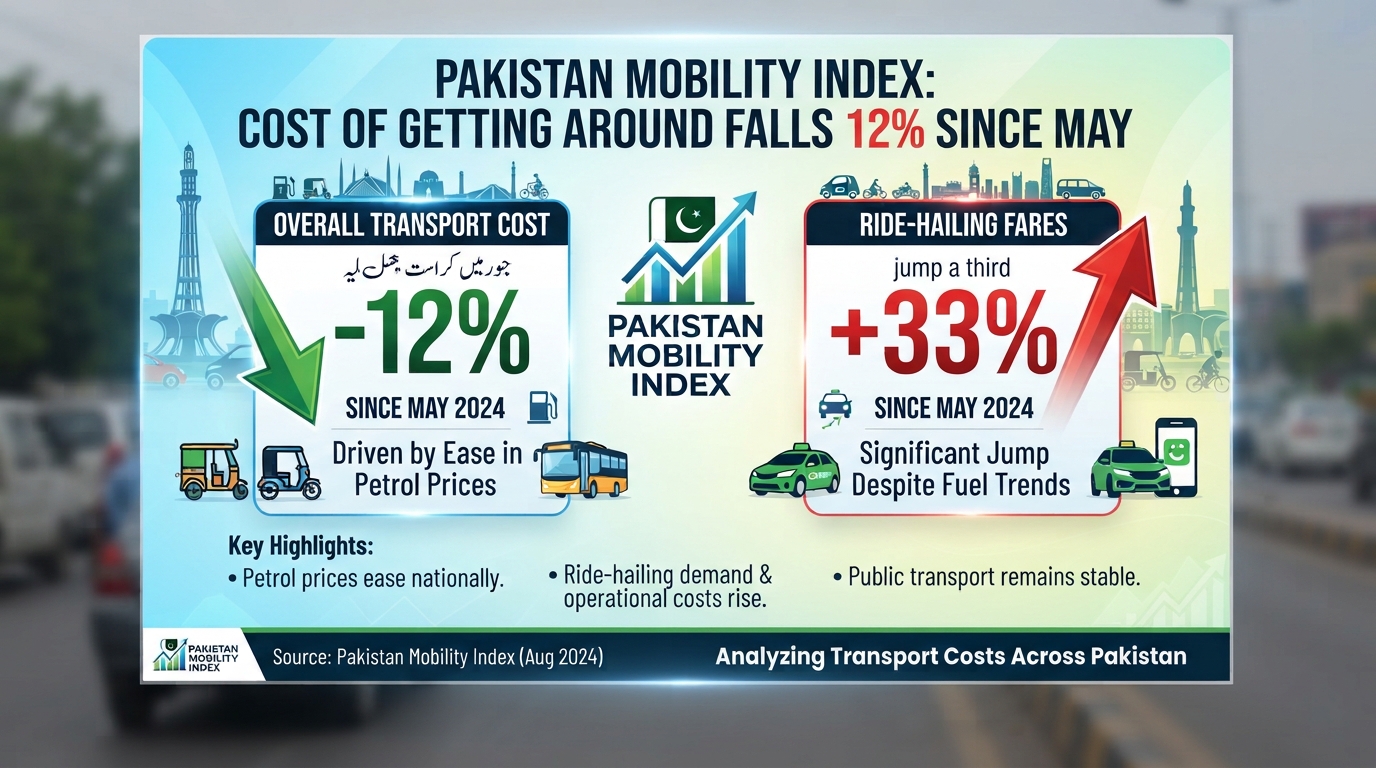

The cost of getting around Pakistan fell to 88.1 on the BusCaro x P&C Mobility Index in November 2026. That is 11.9% below May 2026 (= 100) and 4.4% below September (92.1), according to preliminary figures released today by Pakistan & Counting and BusCaro.
The fall is driven by petrol, the main running cost for most Pakistanis. Petrol averaged Rs 354 a litre in the first two weeks of November, against Rs 375 in September and Rs 405 in May.
Ride-hailing moves the other way
App-based ride-hailing fares rose sharply even as fuel got cheaper. Between September and November, the cost of a ride-hailing car rose 33%, from Rs 61.30 to Rs 81.69 per kilometre. Ride-hailing rickshaws rose 32%, from Rs 49.55 to Rs 65.24, and ride-hailing bikes rose 29%, from Rs 21.98 to Rs 28.40.
Over the same period, the fuel cost of running a private vehicle fell 5.5%. An own motorcycle fell from Rs 6.81 to Rs 6.44 per kilometre, an own car from Rs 24.78 to Rs 23.42, and a private rickshaw from Rs 11.71 to Rs 11.06. Shared commuting on BusCaro fell 3% to Rs 7.75 per kilometre.
Public transport remains cheapest
Government public transport remains the cheapest way to travel, at Rs 2.17 per kilometre, down from Rs 2.23 in September. A kilometre by ride-hailing car now costs nearly 38 times as much.
About the index
The BusCaro x P&C Mobility Index tracks what it costs the person travelling to cover one kilometre in Pakistan, across eight modes of transport, priced on a standard 20 km trip. Ride-hailing fares are in-app quotes for Yango, inDrive and Bykea, collected by BusCaro at peak and off-peak hours. Own-vehicle costs are fuel only, based on the top-selling models and published fuel prices. Public transport combines official fares on six BRT systems with the fuel cost per seat of buses and wagons. The national index is weighted by each mode’s share of the national vehicle fleet, using NTRC data from the Pakistan Economic Survey 2024-25.
These figures are preliminary. They use fuel prices to 13 November 2026 and ride-hailing fares collected on 10 November 2026. The final November reading will be published in early December.
For the full methodology and more details, visit pakistanandcounting.com.